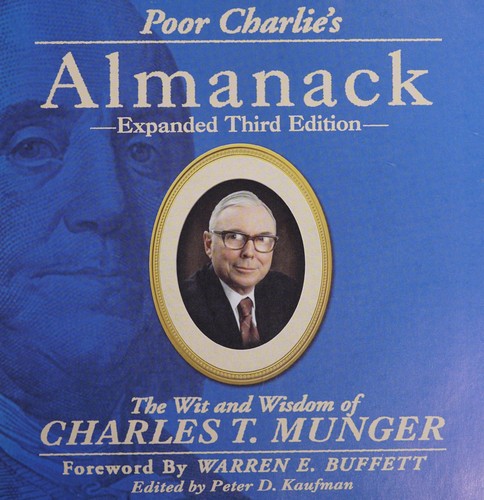
Author: Charlie Munger, compiled by Peter D. Kaufman
First Published: 2005
Pages: 548
Publisher: Stripe Press (expanded edition, 2023)
Difficulty: Intermediate
"Knowing what you don't know is more useful than being brilliant." — Charlie Munger
Why This Book Matters
If The Intelligent Investor teaches you what to buy and Security Analysis teaches you how to calculate what it's worth, Poor Charlie's Almanack teaches you how to think about the entire process.
Charlie Munger was Warren Buffett's partner for over 60 years. During that time, Berkshire Hathaway compounded at roughly 20% annually, turning a failing textile mill into one of the most valuable companies on earth. Munger's contribution was not just finding good investments — it was building the intellectual operating system that made consistently good decisions possible.
This book collects Munger's major speeches and talks, each one a masterclass in clear thinking. The result is not a conventional investing manual — it is a guide to rational decision-making that happens to be written by one of the greatest investors who ever lived.
About Charlie Munger (1924–2023)
Charles Thomas Munger was born in Omaha, Nebraska in 1924. He studied mathematics at the University of Michigan, served as a meteorologist in the Army Air Corps during World War II, and graduated from Harvard Law School without an undergraduate degree — admitted on the strength of his intellect alone.
After a successful career as a real estate attorney and investor, Munger partnered with Warren Buffett in 1978 as vice chairman of Berkshire Hathaway. The partnership became the most successful in investment history.
Munger's influence on Buffett — and on value investing as a whole — was transformative. He convinced Buffett to move beyond Graham's "cigar butt" approach (buying mediocre companies at dirt-cheap prices) toward buying wonderful businesses at fair prices. The See's Candies acquisition in 1972, which Munger championed, was the turning point.
Munger passed away on November 28, 2023, at the age of 99. FairValueLabs dedicates its Value Investing Academy to his memory.
The Mental Models Framework
Munger's most important intellectual contribution is the concept of a "latticework of mental models" — the idea that great decisions require thinking across multiple disciplines, not just finance.
Munger argued that most professionals suffer from "man with a hammer syndrome" — when your only tool is a hammer, every problem looks like a nail. An economist sees every problem as an economics problem. A lawyer sees every problem as a legal problem. The result is consistently poor decisions.
The antidote is building a toolkit of fundamental models from multiple fields:
- Psychology: Understanding cognitive biases (why people systematically make irrational decisions)
- Mathematics: Compound interest, probability, expected value
- Physics: Critical mass, tipping points, feedback loops
- Biology: Evolution, adaptation, competitive exclusion
- Economics: Incentive structures, opportunity cost, comparative advantage
- Engineering: Redundancy, margin of safety, breakpoints
When you analyze a business decision through multiple lenses simultaneously, you see things that specialists miss. This is why Munger was so often right when Wall Street consensus was wrong — he was processing information through more mental models than anyone else in the room.
Psychology of Human Misjudgment
The landmark speech in Poor Charlie's Almanack is "The Psychology of Human Misjudgment," where Munger catalogs 25 standard causes of human error. This speech has been studied by investors, executives, and psychologists worldwide.
Key biases that destroy investment returns:
- Incentive-caused bias: "Never ask a barber if you need a haircut." Wall Street analysts have incentives to recommend stocks, not to tell the truth.
- Consistency and commitment bias: Once you buy a stock, you become psychologically committed to your thesis and ignore disconfirming evidence.
- Social proof: When everyone is buying, it feels safe. This is exactly when it is most dangerous.
- Loss aversion: The pain of losing $100 is roughly twice the pleasure of gaining $100. This causes investors to hold losers too long and sell winners too early.
- Authority bias: Trusting a famous investor's pick without doing your own analysis.
Munger's point is not merely academic — it is practical. If you understand how your brain systematically deceives you, you can build processes that counteract these biases. Checklists, written investment theses, predetermined sell criteria — these are all tools for protecting yourself from your own psychology.
Quality Over Cheapness
Munger's most consequential influence on Buffett was the shift from quantity-based value investing to quality-based value investing.
Graham's original approach was statistical: find stocks trading below liquidation value and buy a basket of them. Some will be duds, but on average the portfolio wins. This works, but it has limitations — you end up owning a lot of mediocre businesses, trading frequently, and never enjoying the benefits of compounding within a single great business.
Munger's insight: a wonderful business at a fair price will compound your wealth for decades. A mediocre business at a wonderful price gives you a one-time gain at best. The math overwhelmingly favors quality over cheapness when your time horizon is long.
This is the philosophy behind FairValueLabs' Moat Ratings system. We don't just screen for cheap stocks — we screen for stocks with durable competitive advantages that can compound returns over time. A Wide Moat stock trading at fair value is often a better investment than a No Moat stock trading at half its book value.
How FairValueLabs Applies These Ideas
| Munger's Concept | FairValueLabs Tool | What It Does |
|---|---|---|
| Quality over cheapness | Moat Ratings | Evaluates competitive advantage durability |
| Inversion (avoid catastrophe) | Risk Audit | Screens for bankruptcy risk first |
| Mental models (multi-factor) | Stock Analysis Pages | Multiple lenses on every company |
| Psychology of misjudgment | Value Investor Quiz | Tests whether you understand the business before buying |
| Patience and discipline | Strike Zone | Only highlights when all criteria align |
Munger's legacy is not a formula — it is a way of thinking. FairValueLabs encodes that thinking into systematic tools, so every investor can benefit from the intellectual framework that built Berkshire Hathaway.