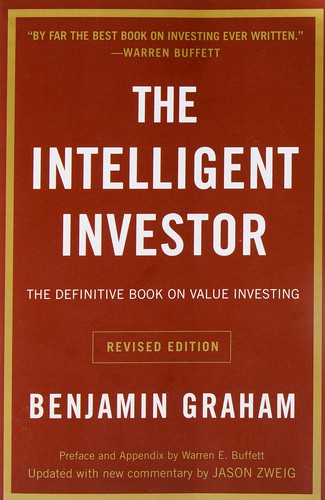
Author: Benjamin Graham
First Published: 1949
Pages: 640 (revised edition)
Recommended Edition: HarperBusiness, 2003 (with Jason Zweig commentary)
Difficulty: Intermediate
"By far the best book on investing ever written." — Warren Buffett
Why This Book Matters
The Intelligent Investor is not a book about picking stocks. It is a book about how to think about investing — and that distinction is everything.
Before Graham published this book in 1949, there was no coherent framework for individual investors. People bought stocks based on tips, hunches, and momentum. The very idea that a stock had an "intrinsic value" independent of its market price was revolutionary. Graham didn't just introduce this concept — he built an entire intellectual framework around it that still governs how the world's greatest investors operate.
Warren Buffett read the book at age 19 and has said it changed his life. He enrolled at Columbia specifically to study under Graham. Decades later, managing hundreds of billions of dollars, Buffett still refers to chapters 8 and 20 as containing everything an investor needs to know.
The book matters today because human psychology hasn't changed. Markets still swing between greed and fear. Investors still confuse price with value. Graham's framework is the antidote to every behavioral trap that destroys portfolios.
About Benjamin Graham
Benjamin Graham (1894–1976) is universally recognized as the father of value investing and security analysis. Born in London, raised in New York after his family emigrated when he was a year old, Graham graduated from Columbia University at 20 and went to work on Wall Street.
After losing heavily in the 1929 crash, Graham spent years developing a systematic approach to investing that would protect against catastrophic loss. The result was Security Analysis (1934), co-authored with David Dodd, and later The Intelligent Investor (1949).
Graham taught at Columbia Business School for decades, where his students included Warren Buffett, Walter Schloss, Irving Kahn, and other investors who would go on to compile extraordinary track records — all using variations of the framework Graham taught them.
Key Concepts
The Intelligent Investor introduces five ideas that remain the foundation of rational investing:
- Investing vs. speculation — An investment operation is one which, upon thorough analysis, promises safety of principal and an adequate return. Operations not meeting these requirements are speculative.
- Mr. Market — The market is a moody business partner who offers to buy or sell every day at different prices. You are free to ignore him.
- Margin of safety — Only buy when the price is significantly below your estimate of intrinsic value. The gap protects you from errors in analysis and unforeseen events.
- Defensive vs. enterprising investor — Two legitimate approaches based on how much time and effort you are willing to invest.
- The market as a voting machine and weighing machine — In the short run, the market reflects popularity. In the long run, it reflects value.
Mr. Market
Graham's most famous allegory appears in Chapter 8. Imagine you own a small share of a private business. Every day, a partner named Mr. Market shows up and offers to buy your share or sell you his — at a price that changes based on his mood.
Some days Mr. Market is euphoric and names a ridiculously high price. Other days he is depressed and will sell for almost nothing. The key insight: you are under no obligation to trade with him. His mood is his problem, not yours.
This reframing is profound. Most investors treat the market as an authority — if the price drops, something must be wrong. Graham says the opposite: the market is there to serve you, not to instruct you. A falling price is only a problem if the underlying business is deteriorating. If the business is fine, a lower price is simply a better deal.
FairValueLabs applies this directly: our Fair Value Lab calculates what a business is worth based on fundamentals, independent of Mr. Market's daily mood. When price is below fair value, Mr. Market is offering you a bargain.
Margin of Safety
Chapter 20 — the final chapter — is where Graham distills everything into a single principle. The margin of safety is the gap between a stock's intrinsic value and its market price. If you estimate a company is worth $100 per share and you buy at $65, you have a 35% margin of safety.
Why does this matter? Because estimates are always imperfect. Earnings might decline. The economy might weaken. Your analysis might contain errors. The margin of safety absorbs these shocks. It is the engineering concept of building a bridge to hold 30,000 pounds when you expect 10,000-pound trucks — not because you're pessimistic, but because you're prudent.
Graham insisted that margin of safety is not just a calculation — it is a mindset. It means always asking "what could go wrong?" before asking "how much could I make?" This is the philosophical foundation of our Risk Audit, which screens every stock for bankruptcy risk before anything else.
Defensive vs. Enterprising Investor
Graham divides investors into two categories — not by skill, but by commitment:
The defensive investor wants adequate results with minimal effort. Graham recommends a diversified portfolio of high-quality, conservatively-financed companies purchased at reasonable prices. The defensive investor does not try to beat the market — the goal is to avoid being beaten by it.
The enterprising investor is willing to dedicate significant time and effort to security analysis. This investor actively searches for undervalued situations, special situations, and opportunities that require deeper research. The reward for the extra work is the potential for above-average returns.
Both approaches are valid. What Graham explicitly warns against is the middle ground — the investor who wants superior returns but is not willing to do the work. This leads to speculation disguised as investing.
FairValueLabs is built to support both types: the Strike Zone gives defensive investors a pre-screened list of opportunities, while the detailed stock analysis pages give enterprising investors the data they need for deep research.
How FairValueLabs Applies These Ideas
Every tool on FairValueLabs traces directly to a concept in The Intelligent Investor:
| Graham's Concept | FairValueLabs Tool | What It Does |
|---|---|---|
| Margin of Safety | Fair Value Lab | Calculates intrinsic value and identifies stocks trading below it |
| Mr. Market | Strike Zone | Highlights when Mr. Market is offering bargains |
| Safety of Principal | Risk Audit | Screens for bankruptcy risk using Altman Z-Score |
| Defensive Diversification | Moat Ratings | Identifies companies with durable competitive advantages |
| Adequate Return | Dividend Safety | Grades income reliability from A to F |
Graham wrote The Intelligent Investor for an era of paper ledgers and annual reports delivered by mail. The principles are identical — we just automated them.